Research Activities
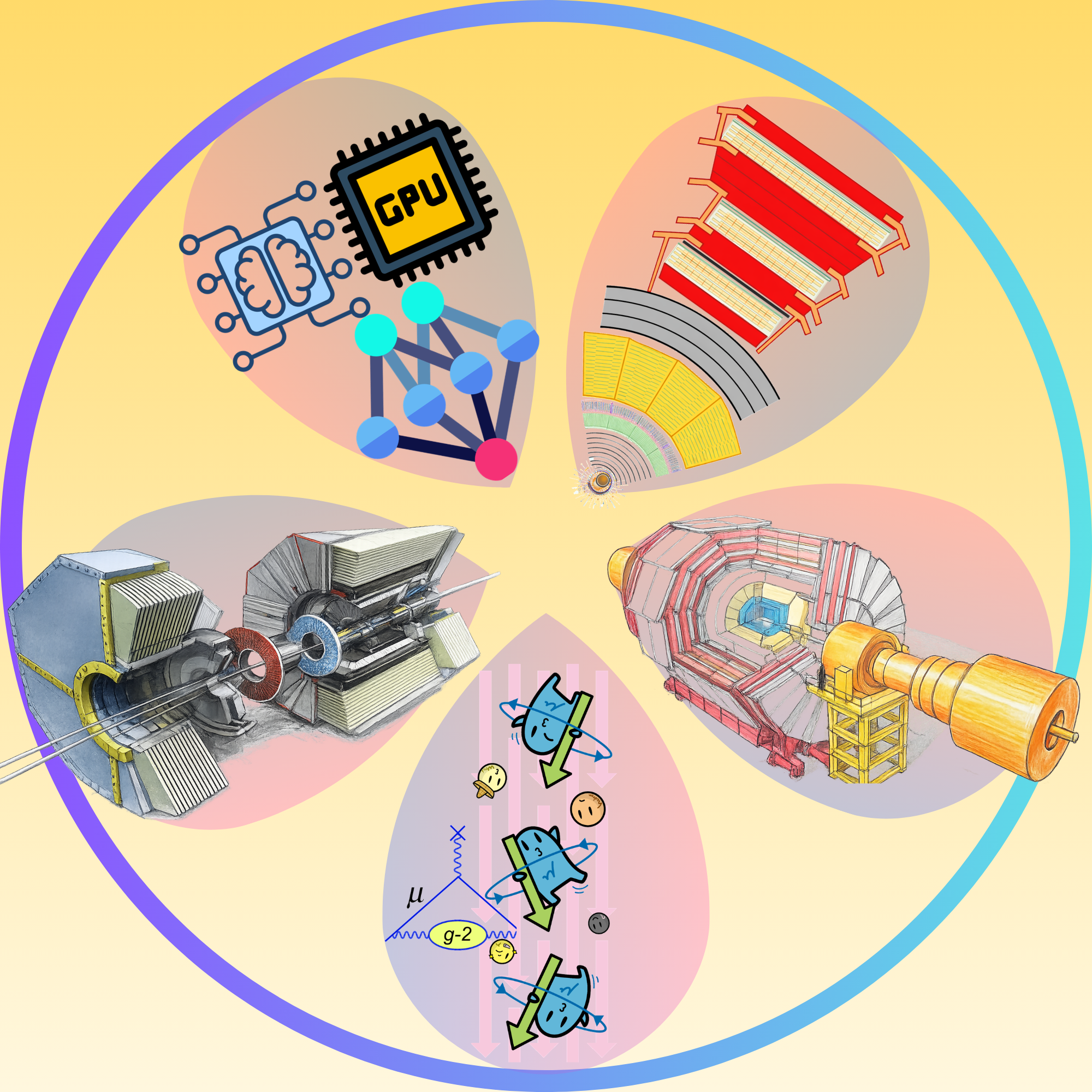
My research primarily focuses on Experimental High Energy Physics (HEP), exploring the fundamental constituents of matter. I am currently involved in three major international collaborations: Belle II, CMS, and the J-PARC Muon g-2/EDM experiment.
Belle II Experiment
2011 – PresentI have been associated with the Belle and Belle II experiments since 2011. My doctoral research was largely focused on bottomonium studies using Belle Υ(2S) data. Following my PhD, I expanded my scope to rare B decays, specifically search for lepton-flavor-violating decays such as B → K*0μ±e∓ and precision measurements of B → K*ℓℓ and B → Kℓℓ. Currently, our group is involved in the studies of B → Kτ+τ- and radiative rare decays of the B meson.
Our group is also working on the measurements of Hadronic decays of B mesons such as B0 → D*-ηπ+ and B+ → D0ηπ+ and inclusive measurements of hadronic B decays, specifically involving baryons.
On the instrumentation front, I contributed to the development and commissioning of a particle identification detector for Belle II, which relies on imaging time-of-propagation (TOP) measurements to distinguish between pions and kaons with high precision.
CMS Experiment
2025 – PresentI recently joined the CMS experiment at the Large Hadron Collider (LHC). My primary hardware contribution is towards the High Granularity Calorimeter (HGCAL) upgrade activities, which is crucial for the High-Luminosity LHC era.
In terms of physics analysis, we intend to contribute to the B-Physics program of CMS. We aim to study b-hadrons such as Bs, Bc, and Λb. These states are largely inaccessible at B-factories (like Belle II) due to kinematic constraints. Ultimately, the CMS B-physics program aspires to complement and independently confirm the findings of B-factories, providing a complete picture of flavor physics.
Muon g-2/EDM Experiment at J-PARC
2022 – PresentRecent discrepancies between the Standard Model (SM) prediction of the anomalous magnetic moment of the muon, aμSM, and experimental measurements, aμexp, suggest the possibility of new physics. The proposed J-PARC Muon g-2/EDM experiment aims to measure the muon's anomalous magnetic moment with a precision of 460 ppb (systematic + statistical) using reaccelerated ultracold muons injected into a magnetic storage ring.
A crucial aspect of this experiment is the accurate reconstruction of positron tracks from muon decays, currently performed using the Hough transformation technique. However, the current track-finding process is computationally intensive, and a speedup factor of 10 is required for efficient data processing.
To address this challenge, we are developing alternative strategies utilizing Graphical Processing Units (GPUs) and Graph Neural Networks (GNNs) to accelerate track reconstruction without compromising accuracy.
Broad Research Interests
Beyond the specific experiments listed above, I maintain an active interest in interdisciplinary applications of High Energy Physics technologies:
- Radiation Detectors: Development of advanced detection systems for future HEP experiments.
- Medical Physics: Applying particle detection techniques to medical imaging and therapy.
- Artificial Intelligence: Application of Deep Learning and AI in large-scale physics data analysis.